
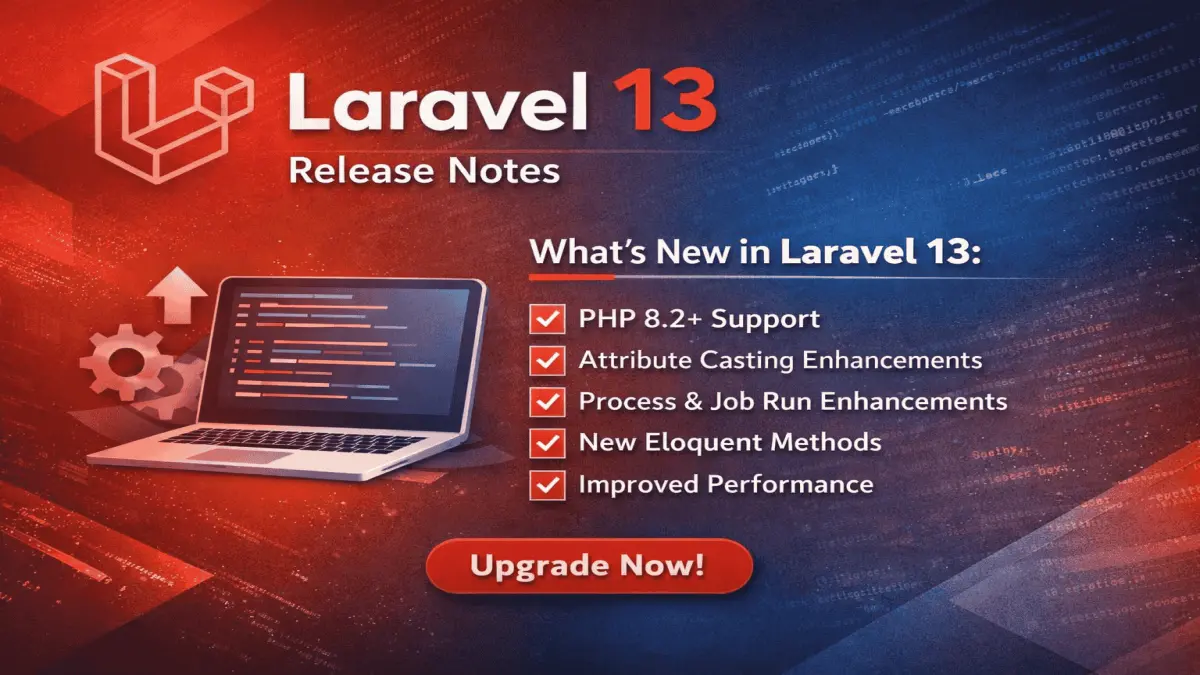
Laravel 13 Release Notes: What's New & How to Upgrade
Table of Contents
🚀 Laravel 13 Upgrade Guide: Full Release Notes, Features & Migration
Laravel 13 is the latest major release of the Laravel framework, focusing on performance, modernization, and long-term stability. Unlike previous versions that introduced large feature sets, Laravel 13 emphasizes improving the core foundation by aligning with modern PHP standards and removing legacy code.
This guide covers everything you need to know about Laravel 13, including new features, breaking changes, performance improvements, and a complete upgrade process.
🔥 Overview of Laravel 13
Laravel follows a yearly release cycle, and version 13 continues that tradition with a strong focus on stability and scalability. The framework now requires modern PHP versions and updated dependencies, making it faster and more secure for production applications.
- Release: Q1 2026
- Bug Fix Support: ~18 months
- Security Support: ~2 years
⚡ Key Highlights of Laravel 13
1. PHP 8.3+ Requirement
Laravel 13 requires PHP 8.3 or higher, dropping support for older versions. This allows developers to use advanced features like typed constants and improved performance optimizations.
2. Improved Performance
Laravel 13 benefits directly from PHP 8.3 improvements, offering better memory usage, faster request handling, and improved API performance. Applications can see noticeable speed improvements without changing code.
3. Cleaner Codebase
Legacy polyfills and backward compatibility layers have been removed. This makes the framework lighter, easier to maintain, and more future-ready.
4. Updated Dependencies
Laravel 13 aligns with newer Symfony components, ensuring better stability and security while keeping the framework modern.
🆕 New Features in Laravel 13
✔ Cache Improvements
Laravel introduces a Cache::touch() method, allowing developers to extend cache lifetime without retrieving the data.
✔ Queue Enhancements
Improved queue handling with better control over job execution and exception handling.
✔ Routing Improvements
Subdomain routing is now more predictable and prioritized correctly for complex applications.
✔ Model Safety Enhancements
Laravel now prevents incorrect model initialization during boot methods, reducing hidden bugs.
✔ Better Developer Experience
Enhanced CLI tools, improved debugging, and cleaner syntax help developers build applications faster.
⚠️ Breaking Changes in Laravel 13
When upgrading, you should be aware of these important breaking changes:
- Minimum PHP version upgraded to 8.3
- Removed deprecated functions and polyfills
- Updated dependency versions (Symfony, packages)
- Stricter type enforcement
These changes may require updates in legacy applications, especially those running older PHP versions.
🛠️ Step-by-Step Laravel 13 Upgrade Guide
Step 1: Check PHP Version
php -v
Ensure your server runs PHP 8.3 or higher.
Step 2: Update composer.json
"require": {
    "php": "^8.3",
    "laravel/framework": "^13.0"
}
Step 3: Run Composer Update
composer update
Step 4: Clear Cache
php artisan config:clear
php artisan cache:clear
php artisan view:clear
Step 5: Test Application
Run all tests and verify functionality including APIs, database queries, and integrations.
📊 Performance Improvements Explained
Laravel 13 introduces performance gains through PHP 8.3 features such as JIT optimization and reduced memory usage. Benchmarks show improved throughput, especially in API-based applications. :contentReference[oaicite:4]{index=4}
🔐 Security Enhancements
Security is improved by removing outdated dependencies and adopting newer encryption and framework components. This reduces vulnerabilities and strengthens application security.
💡 Why Upgrade to Laravel 13?
- Better performance
- Modern PHP support
- Cleaner and maintainable code
- Improved security
- Future-ready architecture
⚙️ Best Practices Before Upgrading
- Backup your project
- Use staging environment
- Check third-party package compatibility
- Run automated tests
🚀 When Should You Upgrade?
If you're starting a new project, Laravel 13 should be your default choice. Existing projects should plan upgrades carefully but benefit greatly from improved performance and security.
✅ Conclusion
Laravel 13 is a stability-focused release that modernizes the framework and prepares it for future innovations. While it may not introduce flashy features, its improvements in performance, security, and developer experience make it one of the most important upgrades.
Upgrading to Laravel 13 ensures your application stays fast, secure, and future-ready.







0 Comments